Every week another headline asks whether AI will replace QA. Every week the reassuring answer circulates underneath it: learn the AI tools, become an AI-augmented tester, sit in the loop as the human supervisor, and you will be fine. It is sensible advice. It is also, quietly, the wrong frame. It tells you to run faster on a track that is being shortened.
The threat was never the machine. It was always the kind of work you were selling.
Here is the distinction the headlines blur. There are two things happening when you test software. One is execution: running the scripted case, working the regression checklist, confirming the build does what the spec said it would. The other is judgment: deciding what is worth testing at all, sensing where the real risk to a user lives, knowing that a 200ms delay is fatal on a checkout page and irrelevant on an internal admin tool. Execution is repeatable. Judgment is not. Machines are extraordinary at the first and clumsy at the second, and the market has started to price that divide out loud. The recent State of Testing work makes it plain: testers who moved into strategy and quality judgment are commanding a premium, while those who stayed in pure execution are quietly being marked down. Not punished for testing. Punished for only executing.
If you feel the floor shifting, that is not paranoia. It is information.
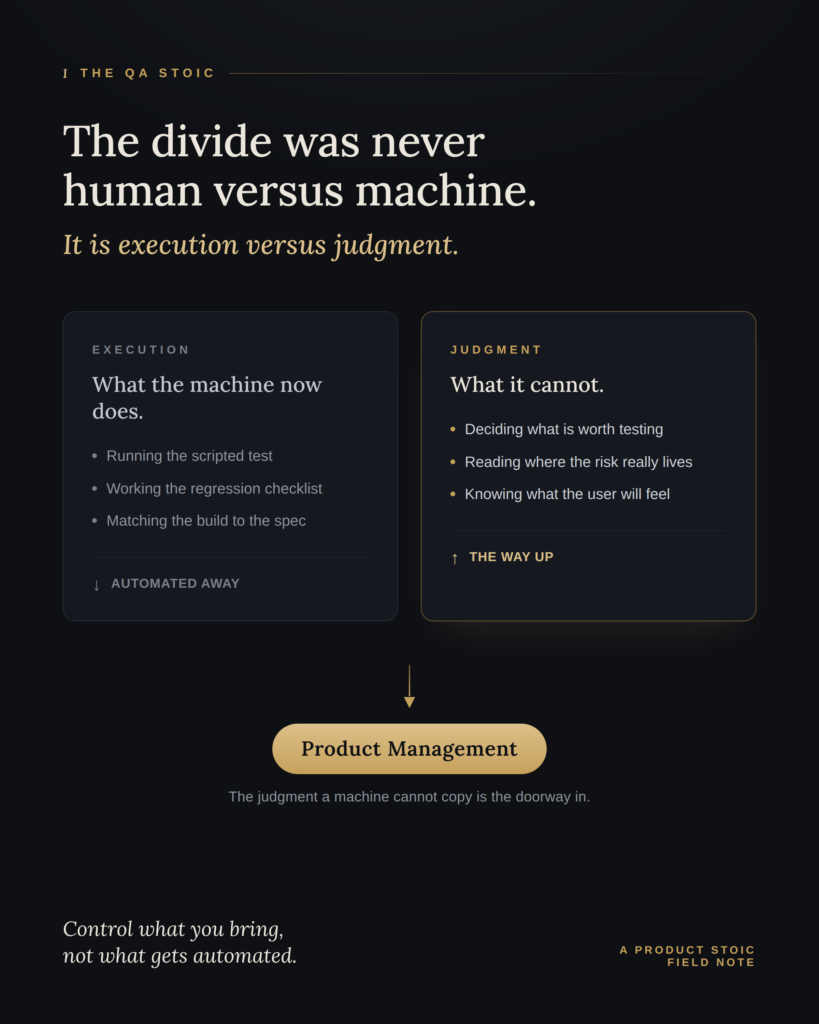
Now the part the reassurance industry leaves out. Stoicism is built on a single, unglamorous distinction: some things are within your control and most are not, and nearly all suffering comes from gripping the second kind. You cannot control that execution is being automated. That decision is being made far above your desk, by economics rather than malice, and no amount of upskilling on the latest plain-language test tool will reverse it. What you can control is what you choose to trade in. You can keep selling the commodity that is falling in value, or you can start trading in the thing that is rising. The panic in the testing forums is the sound of people gripping what they were never going to be allowed to keep.
So move your attention to what you can still build.
And here is what almost no one connects out loud. The judgment that survives in QA is the same judgment that defines product management. Deciding what is worth doing. Reading where the risk to the user actually sits. Choosing what to ship and what to hold. A strong tester already does a junior version of this every single day. When you ask “should we even be building this flow?” rather than “does this flow match the spec?”, you have stopped executing and started doing product. The move from QA to PM is not emigration to a foreign country. It is a promotion of a faculty you already own, applied earlier in the line, where the decisions are still cheap to change.
I watched this happen with someone I coached. In QA she was the person who, two days before a release, would stop the room and say the feature worked exactly as specified and still should not ship, because the spec had quietly asked for the wrong thing. Engineering found her exhausting. Product found her invaluable, once they noticed. Nothing about her changed when she became a product manager except the timing of when she was allowed to speak. She had been doing the job for years. The title simply caught up.
I want to be honest about the cost, because the calm Stoic answer is not the cold one. It is a real loss to watch a craft you spent years mastering get cheapened in a single news cycle. The discipline does not ask you to pretend that does not sting. It asks you to grieve it briefly, with your full attention, and then to stop letting the grief make your decisions for you. Mourn the part of the role that is leaving. Do not follow it down.
The testers who struggle in the next few years will not be the ones who lacked talent. They will be the ones who kept their judgment quiet, who let “match the spec” be the whole job, who waited for permission to think about the product instead of only the build. The ones who do well will be the ones who recognize that their best instinct was never the manual execution. It was the question underneath it: is this the right thing to build, and is it built for the person who has to live with it?
That question is product management. You have simply been asking it from the wrong seat.
None of this is a reason to flee QA in a panic. Panic is only execution applied to your own career, the same reflex you are trying to leave behind. It is a reason to relocate your judgment to where it is valued most, deliberately and on your own terms. The role is not shrinking for everyone. It is shrinking for the part of you that a machine can copy, and expanding for the part of you that it cannot.
If this named something you have been feeling, the newsletter is the quiet place to keep thinking it through: one field note a week, and nothing else.